- Water source is verified, never assumed from neighbors.
- City water status affects allowable lot splits in rural Poway zones.
- Well yield and water quality are left to licensed specialists.
- Comparables are matched on water and sewer type when possible.
- Septic and well records shorten the inspection and review.
Start with the water source
Most Poway homes draw from the city water system, which stores supply in Lake Poway and treats it at the Lester J. Berglund Water Treatment Plant before sending it through roughly 294 miles of pipe. The raw water itself is imported, arriving from the Colorado River and Northern California. Water rates, meter size and any fire-flow upgrades tied to a remodel are part of that picture as well.
On the outer ranch parcels and in unincorporated pockets nearby, some homes rely partly or entirely on private wells. Brian confirms the source for each assignment rather than assuming, because water status in Poway affects more than the kitchen tap. Under city zoning, a parcel without City water service faces much larger minimum lot sizes in the rural zones, and RR-B and RR-C splits require that service outright.
What gets recorded about a private well
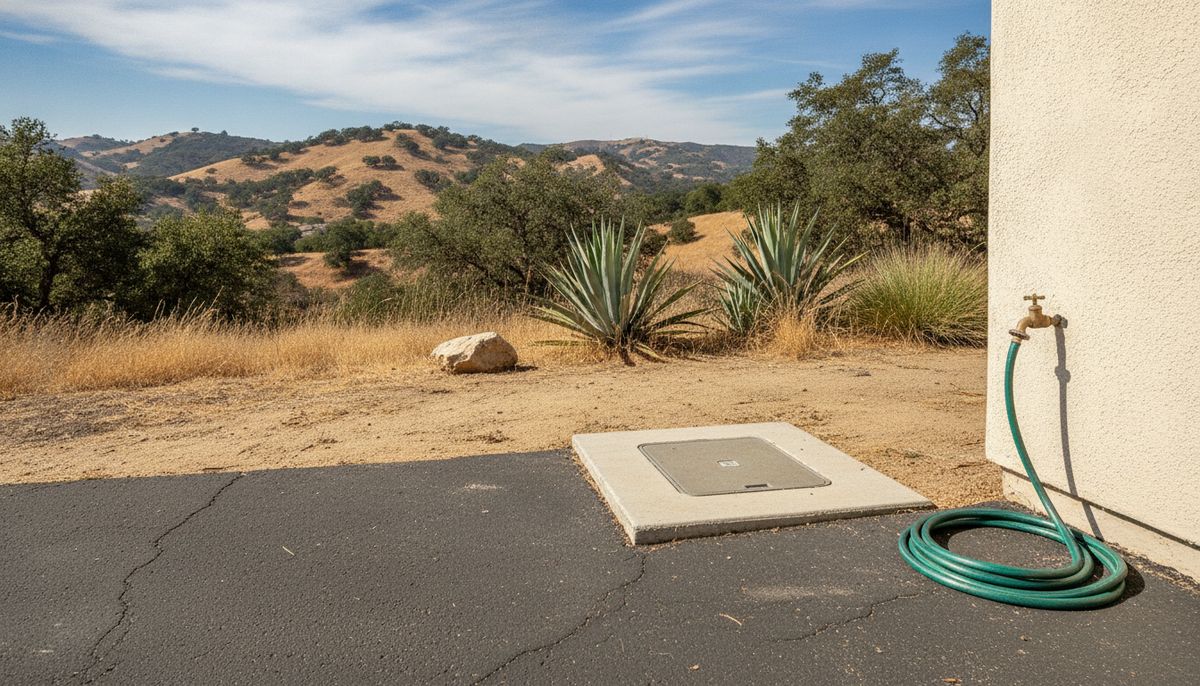
When a property depends on a well, the report states that fact plainly and describes what the appraiser could observe: wellhead location, pressure tank, storage tanks and any treatment equipment. Brian does not test yield or water quality, which belong to licensed well and laboratory professionals. If the owner supplies a recent flow test or lab report, it can be referenced, with its date and source.
Some properties have both a city meter and a well used for landscaping or livestock. That arrangement is noted separately, since buyers often see a working irrigation well as a modest benefit rather than a drawback. A dry or abandoned well is also reported, because buyers and their inspectors will ask whether it was properly sealed. Brian describes what is present and leaves the engineering questions to specialists.
Sewer, septic and the Poway code
Poway's municipal code requires a building to connect to public sewer when the property abuts a sewer line. Where no line is available, an approved private system is allowed, with permits reviewed by the city before going to county health officials. The code generally bars septic on parcels under one acre unless sewer service is shown to be infeasible and the area has no record of past failures.
Existing homes on septic next to a newly installed main may keep their systems until the city determines that public health requires a connection. As a result, a single street can include both sewered and septic homes, and Brian checks rather than reading from a neighbor. Some owners have also connected voluntarily, which can leave an abandoned tank in the yard. Records of such conversions help confirm current status.
Beyond city limits
In unincorporated San Diego County, onsite wastewater systems and water wells are permitted through the County Department of Environmental Health and Quality. Its records can show when a septic system was installed, its design and any repair permits. Gaps in those records are common on older ranch homes, and the appraisal reports what was found and what was not, without guessing at system capacity or remaining life.
Parcels near the city boundary deserve a second look. A home with a Poway mailing address may actually sit in county jurisdiction, so the permitting agency, zoning rules and record sources change with it. Brian confirms jurisdiction through the assessor parcel and city or county maps before deciding which records to request, which keeps the utility description consistent with the correct set of rules.


Utility differences among comparables
Buyers in the Poway hills tend to weigh a known septic system less heavily than an uncertain water supply. A home on a reliable city meter and septic may compete closely with sewered homes of similar size, while one dependent on a single aging well may draw fewer offers. Neighborhood patterns can differ, so the observation is tested against local sales each time rather than applied as a fixed rule.
Where possible, Brian selects comparables with the same combination of water and sewer service. When that is not possible, any adjustment is drawn from paired sales or market reaction, and the report explains the reasoning. A utility difference without measurable effect is noted and left unadjusted. Shared-well agreements and private water companies get a short explanation of their own.
Documents worth gathering
Owners and attorneys can shorten the process by assembling water bills or a well permit, any septic pumping or inspection reports, county or city permit records and recent tests. These papers do not change how the appraiser forms an opinion, but they allow the report to state utility facts with confidence and keep later readers from wondering whether a feature was overlooked.
Propane tanks, solar arrays, backup generators and private road maintenance agreements fall under the same heading. Each is noted where present, with ownership status for leased equipment such as solar panels, since a lease or loan attached to a system can transfer with the house and affect what a buyer is actually acquiring at closing. Leased systems are listed as personal or contractual items, not real estate.